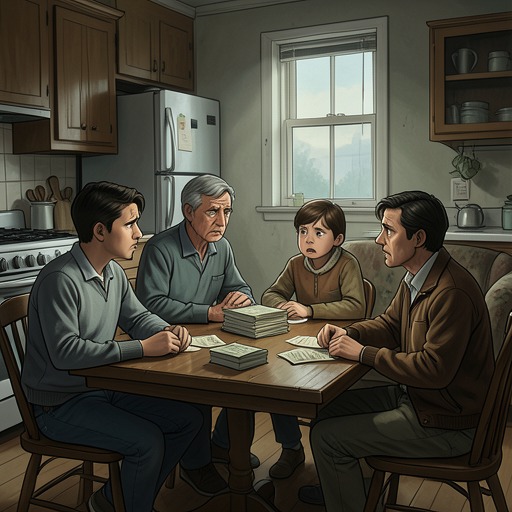
Power is cut off at home and the grandparents provide assistance
On the Come UpThe power cut at the Jackson home turns financial hardship from a constant worry into a crisis the family has to face together. With food at risk of spoiling and Jay ashamed that the family has fallen behind on a bill, Grandma and Granddaddy arrive and offer to take Brianna and Trey home with them. Brianna refuses to leave her mother again; Granddaddy responds with money for the electric bill, offering support without making repayment a condition.
The outage and its immediate stakes
The emergency announces itself through an ordinary object suddenly failing. Jay is preparing French toast when Brianna opens the refrigerator and finds it no longer cold; the kitchen lights and then the other lights in the house also fail. Jay tells the children that the electricity has been shut off. She had understood that there was more time because she had asked the electric company for another week, and the cut leaves the food she has just bought vulnerable to spoiling.
The outage lands amid an already precarious household budget, not as an isolated inconvenience. The family has previously faced an eviction notice, gone without gas, and stretched meals until Jay’s next payday. Jay has also lost her job at the church daycare after riot damage forced Christ Temple’s leaders to redirect its budget toward repairs. The family has applied for food stamps, and the refrigerator had held a carefully counted, limited supply: eight eggs, four apples, a little butter, milk, juice, bread, chicken, peas, and corn. Losing electricity threatens food the family cannot easily replace.
The shutoff also makes a planned meal impossible. Jay had intended to make French toast using a recipe passed down from her mother in New Orleans, a familiar food Brianna associates with home. The contrast is sharp: the family has ingredients, a recipe, and the wish to make breakfast together, but the dark, nonfunctioning refrigerator and powerless kitchen turn those ordinary resources into uncertainty. Poverty appears here through the practical vulnerability of food, utilities, and household routines.
Family arrives and the conflict sharpens
Grandma and Granddaddy come to the house, and Jay initially reacts with frustration when she realizes who is at the door. Grandma looks through the rooms, still alert to the possibility that Jay may have returned to drugs. Her suspicion belongs to a history in which Jay’s addiction once separated her from her children: she left Brianna and Trey with their grandparents because she could not care for them while managing her drug habit. After rehab, Jay returned, but custody was initially limited to alternate weekends and some holidays; she regained the children full-time only after becoming clean, finding work, and renting the house.
The grandparents discover that the dark house is not an electrical-box problem, as Granddaddy first suspects. Jay explains that the electric company has disconnected the service because the family is behind on a payment. She also admits that she applied for food stamps, something Grandma had heard about through a friend. Granddaddy reminds Jay that she could have asked for help, while Jay insists that she has the situation under control. Trey tries to defend the household too, but Granddaddy points to the lights being off as evidence that the crisis is already beyond that claim.
Grandma responds by declaring that Brianna and Trey are coming home with her. The offer is protective, but it also reopens a painful family struggle over who gets to care for the children. Trey says he will stay, refusing to be pulled into the dispute between his mother and grandmother. Grandma says she will not force him, but insists that Brianna is coming with her. Granddaddy interrupts to make clear that Brianna is old enough to decide for herself.
Brianna chooses to stay
For Brianna, the choice is not simply between a dark house and a more secure one. She wants food, lights, and guarantees, and the scene does not pretend those needs have been met. But when she sees fear in Jay’s eyes, she recognizes the expression from the day Jay returned from rehab. Then, Jay had been afraid that her daughter might no longer remember her; now Brianna understands that Jay fears being left again.
Brianna decides that she does not want to be separated from her mother again, even though she cannot know when the lights will come back or whether the family will have enough food. She tells the grandparents that she wants to stay and confirms her decision when Granddaddy asks whether she is sure. Her choice gives emotional force to the family’s earlier separation: the memory of being left with her grandparents shapes what she is willing to endure now. Staying is an expression of attachment, not proof that the material crisis is solved.
Help without repayment
Once Brianna has made her choice, Granddaddy accepts it and asks how much the electric bill is. Jay warns him that she cannot pay him back anytime soon. He gives her money anyway, making clear that repayment is not what matters to him. He invokes Brianna and Trey’s late father, Junior, as someone who would have expected him to help. The assistance is practical and immediate, but it also carries family memory: support for Jay and the children is tied to the bond with the son and father they have lost.
Grandma leaves upset, and Granddaddy observes that grief is part of why she holds so tightly to the children, as though keeping them close helps her hold on to Junior. His explanation does not erase the conflict or turn Grandma’s offer into a simple solution. Instead, the scene shows family care arriving in different forms: Grandma tries to remove the children from hardship, Brianna chooses to remain with Jay, and Granddaddy helps Jay meet the bill without requiring her to surrender her independence or promise repayment.
Significance
The outage makes the Jacksons’ economic insecurity visible through a chain of specific pressures: unemployment after the daycare closes, overdue bills, food assistance, threatened loss of groceries, and the possibility of moving the children out of the home. Each problem narrows the family’s options. Jay’s insistence that she can handle matters sits uneasily beside the dark house, while her parents’ offer of help comes with an emotionally charged question about where the children belong.
Brianna’s decision is shaped by the earlier rupture of Jay’s addiction and return. She chooses continued closeness to her mother while knowing that affection cannot itself restore electricity or guarantee meals. Granddaddy’s money provides a concrete intervention, yet the scene leaves the household’s longer-term hardship intact. Its resolution is therefore neither rescue nor rejection: the family accepts help, Brianna stays, and the fragile household continues with its bonds affirmed but its financial vulnerability unresolved.